Capture your family history before it’s too late

Where do we come from? WHO do we come from? Our family history can give us our identity, shape how we view ourselves and our place in the world.

I am so grateful to my 13 year old self. Because in 1976, I asked my Grandpa to tell me about our family history and I recorded it on a tape recorder. In that recording, he tells the story of how his grand-father, my great-great grandfather, came to Malaya (now Malaysia) from China. He died the following year. It is the only family recording we have of Grandpa’s voice and it is the official account of the story of our family (on my mother’s side).

You can listen to the recording via the player below. (The recording was first published on my previous blog Fusion View)

[audio http://media.ipadio.com/698228_201308311429507588.mp3]


My Grandpa carrying me

In addition to this recording I have recordings of my Grandma and also reams of notes of stories and conversations with other aged relations, collected over time.

Now I am 51+ – about the same age as my Grandpa was in the photo above. My fascination with my family heritage has led me to create Bound Feet Blues, the story performance. I am also writing a book telling the Stories Behind the Story of the show – which will include the story about the Bandit Boy that Grandpa refers to in the recording. Not only has my interest in my family history sparked my creativity, it has also given me a sense of who I am and my place in the world.

Audiences for Bound Feet Blues seem fascinated by the family stories portrayed in the show – and I think this is as much because it prompts them to reflect on their own family and their relationship with their parents and grandparents and great-grandparents as it is to do with any particular interest in the specifics of my family. Many people have said to me that they wish they knew more about their own family history.

If you are interested in your family history, Continue reading

Beautiful women are evil – so said the Ancient Greeks

Bound Feet Blues explores female beauty in the context of Ancient China and the practice of footbinding that was meant to make a woman more beautiful. My work on this project has led me to reflect on modern concepts of beauty in the modern West. Now, I have just  seen this article on the BBC website by historian Bethany Hughes looking at the beauty in the world of the Ancient Greeks – and it points to a rather different view of beauty from what we are used to.

The article says “In ancient Greece the rules of beauty were all important. Things were good for men who were buff and glossy. And for women, fuller-figured redheads were in favour – but they had to contend with an ominous undercurrent”

In Greek mythology, the first woman to be created was …” “the beautiful-evil thing”. She was evil because she was beautiful, and beautiful because she was evil. Being a good-looking man was fundamentally good news. Being a handsome woman, by definition, spelt trouble.”

This point of view contrasts with most notions of beauty which ellide goodness of character with good looks. In Ancient China, for example, an Exemplary Woman was one who was obedient and dutiful – and who was also beautiful, where her beauty was entirely defined by the tiny size of her feet. In modern times, heroines in movies and books tend to be beautiful, too, rather than plain or ugly unless their plainness is part of the plot device/ reason for the story.

However, this Greek notion of female beauty as evil does live on today in the modern trope of the evil seductress whose beauty is Continue reading

Footbinding could have been stopped 400 years early

Bound Feet Blues – the Book continues apace. I am now 42,000+ words in as the fourth chapter builds up its word count. This chapter is entitled “Lotus Feet” and expands on the scenes in the show that dramatize the history of footbinding and the painful process of a mother binding her daughter’s feet.

I can finally share a lot of the research I did for the show but which could not be squeezed into the 25 page script that makes up the one hour long show. It has been very satisfying writing away over the last few weeks, gathering it all together in a coherent way so that those interested in the themes of the show have the chance to learn more about the details and history of this brutal yet macabrely alluring practice.

Here are the last few paragraphs I have written so far;

In 1644, the new emperor of China and the progenitor of the Ming dynasty, a Manchurian who had taken power by violence and invasion, banned footbinding. It was part of a set of laws that dictated what the Chinese people wore, mandating queues for men and the Manchu-style tunic with its high Mandarin collar for both sexes. While those latter laws came to be obeyed and over the centuries even evolved into symbols of Chinese identity, footbinding continued for almost four hundred more years.

 It is a testament to the will and defiance of generations of women.

 Manchu women did not have bound feet. But the allure of the tiny bound foot was so powerful that over time, even they wanted to have dainty little feet. I believe that some Manchu women bound their feet and their daughter’s feet. Others wore a version of high heels that gave the impression of tiny feet beneath their long gowns.

These Manchu shoes sat on top of a small pedestal that acted like short stilts at the centre of the sole. The slightly wider pedestal base acted as the surrogate foot, while the real foot in all its hugeness was balanced a few inches above, hidden from view. These stilts would have made walking precarious and would have required Continue reading

The Institute of Sexology exhibition includes bound feet artefacts

We went to the The Institute of Sexology | Wellcome Collection exhibition just before Xmas. It is a fascinating history of the study of human sexuality and includes a number of artefacts from China showing women with bound feet. I blogged a few days ago about an ivory carving showing a Chinese couple making love which is on show at the exhibiton.


Catch it if you can before Sept 2015. Here is the blurb and also the promotional video:

” ‘The Institute of Sexology’ tells the complex and often contradictory story of the study of sex through Continue reading

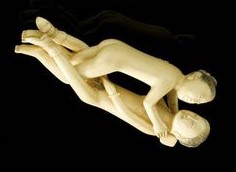
Historical figurine of bound feet woman making love

This tiny ivory couple shows a Chinese man and woman making love. You can see the man on top, with his bare feet. Under him is the woman with her legs wrapped around him. You can just about see her breasts and if you look very closely, you will see her tiny bound feet.


ivory


The original carving can be seen at the Institute of Sexology exhibition at the Wellcome Foundation, which is on till Sept 2015.

Continue reading

Is looking Chinese really so awful?

Looking Western seems to be an ideal of beauty for some Chinese women, according to an article in the Daily Mail. They are getting cosmetic surgery on their faces to remove their Chinese features – making their eyes bigger, sharpening their noses and reshaping their faces to seem longer.  Is looking Chinese really so awful for these women that they feel they have to destroy their own faces to look more Western and therefore in their minds more beautiful?

Looking at the photos in the article, I am reminded of depictions of women in anime comics, which originated in Japan – with large saucer like eyes and heart shaped faces, mapping Western features onto Eastern female faces. The skin tones also seem to have been altered to look paler and pinker. There, too, in those comic books, Western features are idolized.

Chinese woman before and after Westernizing cosmetic surgery

Bound Feet Blues explores why women in ancient China were prepared to do violence to themselves and their daughters in the context of footbinding, which mutilated a girl’s feet beyond repair. That brutal cultural practice died out about 70 years ago. But it looks like it has returned but in another form.

The underlying message of both bound feet and this Westernizing cosmetic surgery seems to me to be that Continue reading

An elderly lady recalls her experience of footbinding [video]

In this video, a 90+ year old Chinese lady in Malaysia is interviewed, talking about her experience of having her feet bound.

The practice of footbinding did not take place in Malaysia but many women who had had their feet bound as childre migrated to Malaya (as Malaysia used to be called before independence from British rule) in later life.


Continue reading

Researching the history of the iconic cheongsam, the Chinese traditional dress

On this wet Sunday afternoon, I am feeling very sorry for myself – laid up with a cold – but I am distracting myself by researching the history of the the cheongsam for Bound Feet Blues, The Book.


What I am learning is that clothing has national and political significance. The cheongsam originated with Manchu rule in China when the Manchurians from the North East overthrew the Ming Dynasty in 1644. They required all men to wear their hair in a plait – known as a queue – and everyone had to wear clothing in the Manchu style: with the high collar and side buttons. Those who defied this requirement could be punished by death. It was a way of dominating the Continue reading

Performance photo – the most prized, smallest foot was “the golden lotus”

I perform Bound Feet Blues without any costumes or props – or even any shoes. My aim is to invite the audience to experience the show in the way that we have all experienced stories being told to us when we were children – that is, by co-creating the characters, events and landscapes in our imaginations.

I use my left hand to map the process of footbinding – it starts off as a normal “foot” and is steadily contorted and “broken” into the twisted shape that you see in the photo below. For comparison, I’ve also found a photo of an actual bound foot – also below.


This performance photo was taken at the scratch night in March at Conway Hall.

The most prized foot was called “the golden lotus” – it was Continue reading

Chilling photo of a castrated Eunuch of Ancient China

While women in Ancient China had to endure their feet being broken and bound in order to conform to the traditional Chinese cultural ideal of feminine beauty, some men endured castration in order to rise in the ranks of power.

This is a chilling photo of what castration meant for a man of that time

Eunuch-is a castrated man. In ancient China, castration was a traditional punishment or a means of gaining employment. During the Ming Dynasty there were 70,000 eunuchs, some by self-castration. Some of these individuals had powers that were greater than those of the prime ministers. Self-castration became illegal and by 1912, less than 500 eunuchs existed and their jobs ended. Eunuchs castrated before puberty were valued for their exceptional high pitch voices.


According to  Green 9999 on Pinterest:

Eunuch-is a castrated man. In ancient China, castration was a traditional punishment or a means of gaining employment. During the Ming Dynasty there were 70,000 eunuchs, some by self-castration. Some of these individuals had Continue reading