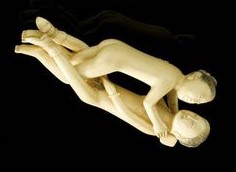
We went to the The Institute of Sexology | Wellcome Collection exhibition just before Xmas. It is a fascinating history of the study of human sexuality and includes a number of artefacts from China showing women with bound feet. I blogged a few days ago about an ivory carving showing a Chinese couple making love which is on show at the exhibiton.
Catch it if you can before Sept 2015. Here is the blurb and also the promotional video:
” ‘The Institute of Sexology’ tells the complex and often contradictory story of the study of sex through Continue reading
This tiny ivory couple shows a Chinese man and woman making love. You can see the man on top, with his bare feet. Under him is the woman with her legs wrapped around him. You can just about see her breasts and if you look very closely, you will see her tiny bound feet.
The original carving can be seen at the Institute of Sexology exhibition at the Wellcome Foundation, which is on till Sept 2015.
If you missed the sellout showcase performance of Bound Feet Blues in October, you can watch a selection of highlights in this short video (under 2 mins):
The show received 4+Star reviews and we are planning a 3 week run back in London’s West End in Nov/ Dec 2015 – more details to be announced shortly.
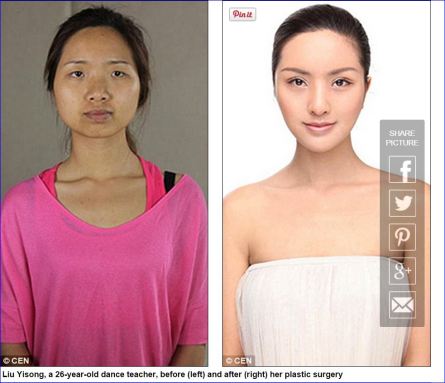
Looking Western seems to be an ideal of beauty for some Chinese women, according to an article in the Daily Mail. They are getting cosmetic surgery on their faces to remove their Chinese features – making their eyes bigger, sharpening their noses and reshaping their faces to seem longer. Is looking Chinese really so awful for these women that they feel they have to destroy their own faces to look more Western and therefore in their minds more beautiful?
Looking at the photos in the article, I am reminded of depictions of women in anime comics, which originated in Japan – with large saucer like eyes and heart shaped faces, mapping Western features onto Eastern female faces. The skin tones also seem to have been altered to look paler and pinker. There, too, in those comic books, Western features are idolized.
Bound Feet Blues explores why women in ancient China were prepared to do violence to themselves and their daughters in the context of footbinding, which mutilated a girl’s feet beyond repair. That brutal cultural practice died out about 70 years ago. But it looks like it has returned but in another form.
The underlying message of both bound feet and this Westernizing cosmetic surgery seems to me to be that Continue reading
As you may know, I’ve been working on Bound Feet Blues – The Book which brings together the stories behind the story of the show. I have just finished Chapter One: Stilettos, bringing it home at 17,000+ words. The chapter goes behind the scenes of the opening sequence of the theatre performance, which depicts me walking to a ball in stilettos and a red cheongsam, aged 20.
I share stories of my coming of age as a young woman at Oxford, falling in love and discovering the power of my femininity – and how I transformed from a shy, awkward fresher into a woman who can sashay along confidently in a slinky evening gown.
” You must be sleek and slim – and curvaceous, but only in the right places”
Here is an extract, describing what it takes to wear the tight fitting, figure hugging, seductive Chinese traditional dress, while walking in heels…

~~~
“There is something about the severity of the high collar and the unforgiving close fit of the cheongsam that requires a sternness in your upper body as you wear it. You cannot slack if you are to keep the cloth from creasing over your belly or pulling up over any untoward bumps and crevices. You must be sleek and slim – and curvaceous, but only in the right places, which is why the dress has to be tailor made for exactly your shape and cannot be Continue reading
The Guardian has a terrific gallery of photos showing a selection of totally bonkers high heels including this pair of killer stilettos…. – from an exhibition aptly entitled Killer Heels at the Brooklyn Museum, on now till 15 Feb 2015.

The gallery shows that high heels were also in fashion in ancient China – see this pair below. They emulated bound feet for the ruling Continue reading
On this wet Sunday afternoon, I am feeling very sorry for myself – laid up with a cold – but I am distracting myself by researching the history of the the cheongsam for Bound Feet Blues, The Book.

What I am learning is that clothing has national and political significance. The cheongsam originated with Manchu rule in China when the Manchurians from the North East overthrew the Ming Dynasty in 1644. They required all men to wear their hair in a plait – known as a queue – and everyone had to wear clothing in the Manchu style: with the high collar and side buttons. Those who defied this requirement could be punished by death. It was a way of dominating the Continue reading
Here’s a short video interview of me talking about the inspirations behind Bound Feet Blues and the challenges of bringing it to the stage.
It was filmed just after the Heritage Panel that I took part in, discussing the role of heritage in South East Asian Performance with Anna Nguyen of Trikhon Theatre and Elaine Foo of TrueHeart Theatre.
There’s also a short snippet of me performing a scene from the show for the audience at the Heritage Panel.
Enjoy!
I perform Bound Feet Blues without any costumes or props – or even any shoes. My aim is to invite the audience to experience the show in the way that we have all experienced stories being told to us when we were children – that is, by co-creating the characters, events and landscapes in our imaginations.
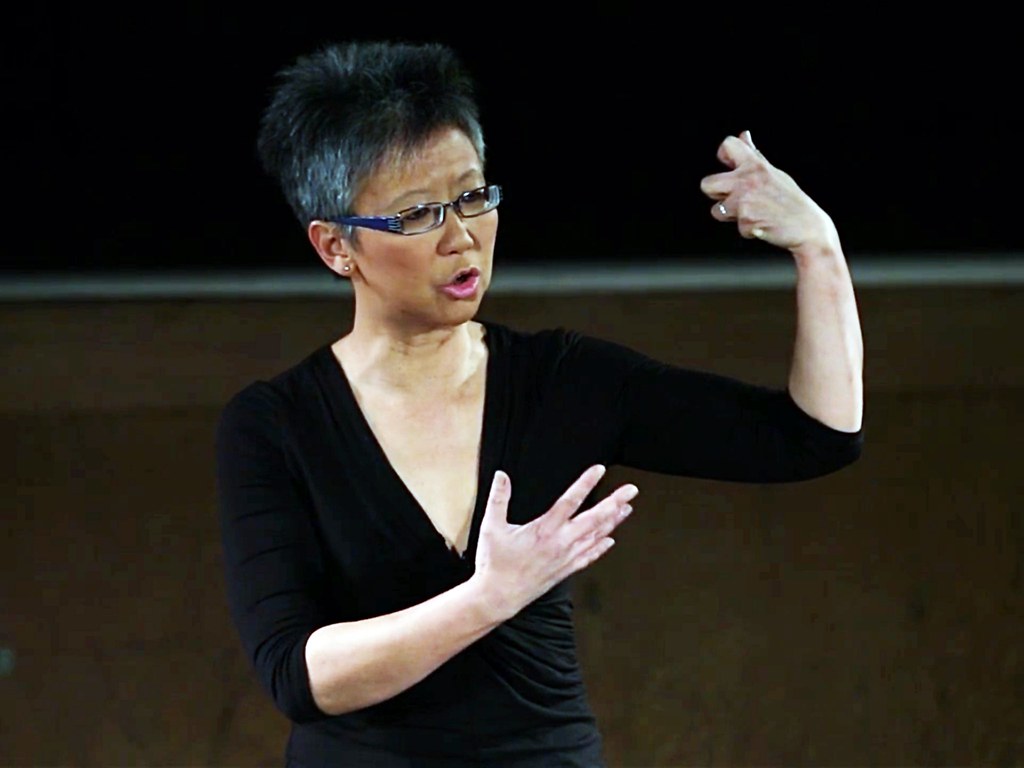
I use my left hand to map the process of footbinding – it starts off as a normal “foot” and is steadily contorted and “broken” into the twisted shape that you see in the photo below. For comparison, I’ve also found a photo of an actual bound foot – also below.
This performance photo was taken at the scratch night in March at Conway Hall.
The most prized foot was called “the golden lotus” – it was Continue reading