How we perform our selves in every day life [Bound Feet Blues, the BOOK]

Bound Feet Blues, the BOOK, explores the theme of performance in theatre and in our every day lives, using the metaphor of bound feet and fashion. Writer/ performer and author of the book, Yang-May Ooi, explains why performance fascinates her.

Yang-May writes:

Bound Feet Blues, my memoir in book form, opens at my first staged performance of the theatre version of the Bound Feet Blues story. The first chapter describes what it felt like for me to step out in front of an audience under the spotlights to perform the story of my family and my own life.

That first performance at Conway Hall described in the book was captured on video – highlights below:

Acting and Authenticity

We sometimes mistake performance or acting as inauthentic. We think that acting means pretending to be someone that we are not. Of course that is factually true when actors play a fictional role or are portraying a real person on film or in a play but even then actors always seek to be real and honest in the emotions that they depict. For me, portraying myself and my family on stage, it was deeply important to be authentic to my own story and also theirs. The emotions and story I portrayed were real and truthful within the frame of the drama.

The experience of that performance made me reflect on the performance of my self over the last few decades.

“Performing” My Life

In the book, Bound Feet Blues, I write about how I “performed” the role of a Bright Young Thing in my student days in Oxford, going to balls and dressing as a beautiful “China Doll”. Later, I “performed” the role of a high-achieving lawyer in London in the yuppy atmosphere of the ’80s. When I came out, I “performed” as a boyish lesbian in baggy chinos and lace ups. It was only after all this experimentation that I finally came to be able to express who I really am – a mix of feminine and masculine, sometimes high powered, sometimes slobby and lazy, sometimes beautifully dressed, sometimes not.
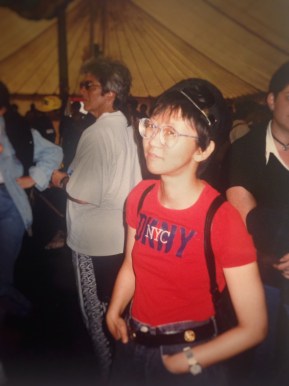
Yang-May Ooi at Pride “performing” the tomboy self. This photo is one of many in her book, Bound Feet Blues

How do you “perform” different aspects of your character?

We all perform who we are to some extent. Think about how you show Continue reading

What LGBTQ stories can teach the world [video] – interview with Yang-May Ooi, writer and performer of Bound Feet Blues

Yang-May Ooi, writer/ performer of Bound Feet Blues, talks about what LGBTQ stories – and esp lesbian stories – can teach the wold about the universal human experiences of love, courage and heroism.

Bound Feet Blues is about more than bound feet. The brutal practice of footbinding in ancient China is a metaphor in the show for the cultural norms that bind us – as women and also in terms of our individual sexuality. An integral part of Continue reading

For National Coming Out Day, read a FREE extract from Yang-May Ooi’s coming out story as told in her memoir Bound Feet Blues, the book

To celebrate National Coming Out Day tomorrow, Sunday 11 Oct, writer/ performer Yang-May Ooi shares an extract from her memoir Bound Feet Blues – A Life Told in Shoes, the book that is inspired by her solo theatre piece of the same name. Bound Feet Blues is as much about Yang-May’s journey to discovering her sexual identity as it is the story of the women in her family. 

Here is the extract from the chapter entitled “Biker Boots” from the book, Bound Feet Blues:

Coming out is a rite of passage.

In the world of debutantes and high society, it is an ancient tradition going back generations. When a young woman comes of age, she is invited to a coming out ball to introduce her to society – and  in the aristocratic classes in Britain, to present her to the monarch. It is her “debut” into the world as an adult – or, rather, as a fertile virgin of a marriagable age. This custom continues to this day among the elite not just in Britain but also, surprisingly, in the ideally classless societies of Australia and the United States.

The coming out ball is the moment when high society gathers to view the future of their dynasties. Debutantes customarily wear white ball gowns, sometimes with long white Cinderella gloves and sometimes with tiaras or both.  If you Google images of  “debutante ball coming out”, you will see that the styles of the ball dresses have changed little since Victorian times and often the young women are indistinguishable from each other in their demure, beautiful uniforms. The eligible young bachelors gather round them in white tie and tails and suddenly, we are back in the world of Jane Austen and Downton Abbey and fairy tale princesses.

For a young woman in that society, to come out is to emerge from Continue reading