4 Sisters over 40 years – Women’s History Month

Bound Feet Blues tells stories from my family’s past as passed down the generations by the women – my mum, my great-grandmother, my auntie. In researching these stories for the show – and also the book that I am currently working on – I looked through my personal photo albums and also asked my mum to send me photos from hers. It was fascinating to watch my family and I evolve, grow up and grow old over the years.

So when I came across this photo project of four sisters photographed every year for forty years by Nicholas Nixon, I was captivated. The forty photos are intimate, moving, poignant.

<p>2007, Cataumet, Mass.</p>

Susan Minot in this NY Times article says:

“Throughout this series, we watch these women age, undergoing life’s most humbling experience. While many of us can, when pressed, name things we are grateful to Time for bestowing upon us, the lines bracketing our mouths and the loosening of our skin are not among them. So while a part of the spirit sinks at the slow appearance of these women’s jowls, another part is lifted: They are not undone by it. We detect more sorrow, perhaps, in the eyes, more weight in the once-fresh brows. But the more we study the images, the more we see that aging does not define these women. Even as the images tell us, in no uncertain terms, that this is what it looks like to grow old, this is the irrefutable truth, we also learn: This is what endurance looks like.”

Do go over to the NY Times article and look at all 40 photos.

Continue reading

A Love Story passed down from My Grandma – Women’s History Month

In Bound Feet Blues, the show, I recount the story of how my parents met – as told to us by my mother when we were kids. On stage, I become my mother as we all curl up in bed and she tells the romantic story of meeting the man who would become her husband.

“How we first met” is a genre of the oral storytelling tradition within families – and also among circles of friends. We all want to know where we come from – even, or especially, as young children. We are trying to figure out who we are and what being alive means. Hearing how our parents met gives us the context and if we’re lucky, it tells us we were born from love.

My grandparents (R) met and fell in love. My parents (L) met and fell in love. So here I am (baby in the middle)


In my story performance, I can only tell the one story ie about how my mother met my father. But there are a number of “how we met” stories in my family. The show is only one hour long – which amounts to 25 pages of text. In the book Bound Feet Blues: The Stories behind the Story that I am currently writing, I have more room to tell those other stories as well.

Here is an extract, telling the love story of my grandparents, my mother’s mum and dad:

“It was funny to think of Grandma and Grandpa – well, before they became Grandma and Grandpa. We loved leafing through their photo album and seeing them so young and fresh-faced, Grandpa in those baggy ‘30s style trousers and Grandma in pretty cheongsams and chunky high heels of that time. It was odd to see them in our minds as two young medical students, hanging out with their pals and horsing around in such a scandalous way. It was odd to see a photo of Grandpa playing rugby and running in a race, looking hunky and sweaty, his Brylcreemed hair flying in the wind.

 “I would go and watch him play matches-lah,” Grandma said coyly. “And then he notice me always there and he Continue reading

Bound Foot Warrior – Qiu Jin – Women’s History Month

She had bound feet but she loved riding and martial arts. She wore men’s clothing and was a firebrand orator. Her name was Qiu Jin and was a revolutionary in the early 1900s in  China.

Here is a snapshot of what Qiu Jin achieved, from Wikipedia:

“She was an eloquent orator who spoke out for women’s rights, such as the freedom to marry, freedom of education, and abolishment of the practice of foot binding. In 1906 she founded a radical women’s journal with another female poet, Xu Zihua, called China Women’s News (Zhongguo nü bao), though it published only two issues before it was closed by the authorities.[4] In 1907 she became head of the Datong school in Shaoxing, ostensibly a school for sport teachers, but really intended for the military training of revolutionaries.”

Of her early life, we learn this from Don Tow:

“Qiu Jin was born in 1875 in Fujian Province in China, and grew up in Shaoxing, Zhejiang Province. As a child of a fairly well-off family, she was very well educated, much more than other girls of her time. She was very good in literature and writing, both prose and poetry. Unlike most other girls, she was also very much interested in the outdoor and physical activities, such as riding horses and martial arts. Although her feet were bound[1] starting from about five years old as was the norm at that time for Chinese girls from reasonably well-off families, she was quite good in martial arts and other physical activities, an indication of her determination, commitment, and drive. Later as she grew older and started advocating equality for women, she stopped binding her feet.” See Qiu Jin (秋瑾) – China’s First Feminist | Don Tow’s Website.

As for footbinding and women’s rights, we can read a snippet of her writing here via the On This Deity blog (15 July 1907 The Martyrdom of Qiu Jin):

“We women, who have had our feet bound from early childhood, have suffered untold pain and misery, for which our parents showed no pity. Under this treatment our faces grew pinched and thin, and our muscles and bones were cramped and distorted. The consequence is that our bodies are weak and incapable of vigorous activity, and in everything we do we are obliged to lean on others … Sisters, let us today investigate the causes which have led to this want of spirit and energy among women. May it not be because we insist on binding up our girls’ feet at an early age, speaking of their “three-inch golden lilies” and their “captivating little steps”?

Continue reading

March is Women’s History Month -2015 theme: Weaving the Stories of Women’s Lives

2015 Theme

It is almost as if the theme of this year’s Women’s History Month was designed just for Bound Feet Blues!

March is Women’s History Month and this year’s theme is Weaving the Stories of Women’s Lives. The website of the National Women’s History Project (US) says of this theme:

“Accounts of the lives of individual women are critically important because they reveal exceptionally strong role models who share a more expansive vision of what a woman can do. The stories of women’s lives, and the choices they made, encourage girls and young women to think larger and bolder, and give boys and men a fuller understanding of the female experience. Knowing women’s achievements challenges stereotypes and upends social assumptions about who women are and what women can accomplish today.”

In my show – and the book – Bound Feet Blues, I tell personal stories from the lives of the women in my family and weave those threads with my own coming out journey. But the themes go beyond the stories of one woman and one family to touch on the universal questions of female desirability, identity  and empowerment. In ancient China, women were objectified as decorative objects through their tiny, crippled bound feet. My great-grandmother broke free from tradition to run away from her cruel husband despite her crippled feet. What cultural traditions still bind us to a standard of beauty that denies us our essential powerful identities? How can we break Continue reading

Capture your family history before it’s too late

Where do we come from? WHO do we come from? Our family history can give us our identity, shape how we view ourselves and our place in the world.

I am so grateful to my 13 year old self. Because in 1976, I asked my Grandpa to tell me about our family history and I recorded it on a tape recorder. In that recording, he tells the story of how his grand-father, my great-great grandfather, came to Malaya (now Malaysia) from China. He died the following year. It is the only family recording we have of Grandpa’s voice and it is the official account of the story of our family (on my mother’s side).

You can listen to the recording via the player below. (The recording was first published on my previous blog Fusion View)

[audio http://media.ipadio.com/698228_201308311429507588.mp3]


My Grandpa carrying me

In addition to this recording I have recordings of my Grandma and also reams of notes of stories and conversations with other aged relations, collected over time.

Now I am 51+ – about the same age as my Grandpa was in the photo above. My fascination with my family heritage has led me to create Bound Feet Blues, the story performance. I am also writing a book telling the Stories Behind the Story of the show – which will include the story about the Bandit Boy that Grandpa refers to in the recording. Not only has my interest in my family history sparked my creativity, it has also given me a sense of who I am and my place in the world.

Audiences for Bound Feet Blues seem fascinated by the family stories portrayed in the show – and I think this is as much because it prompts them to reflect on their own family and their relationship with their parents and grandparents and great-grandparents as it is to do with any particular interest in the specifics of my family. Many people have said to me that they wish they knew more about their own family history.

If you are interested in your family history, Continue reading

Beautiful women are evil – so said the Ancient Greeks

Bound Feet Blues explores female beauty in the context of Ancient China and the practice of footbinding that was meant to make a woman more beautiful. My work on this project has led me to reflect on modern concepts of beauty in the modern West. Now, I have just  seen this article on the BBC website by historian Bethany Hughes looking at the beauty in the world of the Ancient Greeks – and it points to a rather different view of beauty from what we are used to.

The article says “In ancient Greece the rules of beauty were all important. Things were good for men who were buff and glossy. And for women, fuller-figured redheads were in favour – but they had to contend with an ominous undercurrent”

In Greek mythology, the first woman to be created was …” “the beautiful-evil thing”. She was evil because she was beautiful, and beautiful because she was evil. Being a good-looking man was fundamentally good news. Being a handsome woman, by definition, spelt trouble.”

This point of view contrasts with most notions of beauty which ellide goodness of character with good looks. In Ancient China, for example, an Exemplary Woman was one who was obedient and dutiful – and who was also beautiful, where her beauty was entirely defined by the tiny size of her feet. In modern times, heroines in movies and books tend to be beautiful, too, rather than plain or ugly unless their plainness is part of the plot device/ reason for the story.

However, this Greek notion of female beauty as evil does live on today in the modern trope of the evil seductress whose beauty is Continue reading

Footbinding could have been stopped 400 years early

Bound Feet Blues – the Book continues apace. I am now 42,000+ words in as the fourth chapter builds up its word count. This chapter is entitled “Lotus Feet” and expands on the scenes in the show that dramatize the history of footbinding and the painful process of a mother binding her daughter’s feet.

I can finally share a lot of the research I did for the show but which could not be squeezed into the 25 page script that makes up the one hour long show. It has been very satisfying writing away over the last few weeks, gathering it all together in a coherent way so that those interested in the themes of the show have the chance to learn more about the details and history of this brutal yet macabrely alluring practice.

Here are the last few paragraphs I have written so far;

In 1644, the new emperor of China and the progenitor of the Ming dynasty, a Manchurian who had taken power by violence and invasion, banned footbinding. It was part of a set of laws that dictated what the Chinese people wore, mandating queues for men and the Manchu-style tunic with its high Mandarin collar for both sexes. While those latter laws came to be obeyed and over the centuries even evolved into symbols of Chinese identity, footbinding continued for almost four hundred more years.

 It is a testament to the will and defiance of generations of women.

 Manchu women did not have bound feet. But the allure of the tiny bound foot was so powerful that over time, even they wanted to have dainty little feet. I believe that some Manchu women bound their feet and their daughter’s feet. Others wore a version of high heels that gave the impression of tiny feet beneath their long gowns.

These Manchu shoes sat on top of a small pedestal that acted like short stilts at the centre of the sole. The slightly wider pedestal base acted as the surrogate foot, while the real foot in all its hugeness was balanced a few inches above, hidden from view. These stilts would have made walking precarious and would have required Continue reading

Ancient Chinese pornographic painted panels showing woman with bound feet


This Chinese wood and glass mirror box – showing a man and woman making love: you can see her tiny bound feet (c.18th century) Photo: Courtesy Science Museum, London/Science and Society Picture Library
A detail of one of the panels is below – notice the woman’s red shoes and her disproportionately small feet.


 The original panel box can be seen at the Institute of Sexology exhibition in London – on till Sept 2015
See my previous blog posts about the exhibition and other bound feet artefacts you can see there.

Continue reading

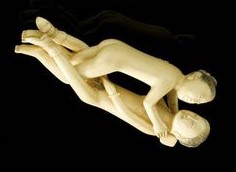
Historical figurine of bound feet woman making love

This tiny ivory couple shows a Chinese man and woman making love. You can see the man on top, with his bare feet. Under him is the woman with her legs wrapped around him. You can just about see her breasts and if you look very closely, you will see her tiny bound feet.


ivory


The original carving can be seen at the Institute of Sexology exhibition at the Wellcome Foundation, which is on till Sept 2015.

Continue reading

Now that’s what I call Killer Heels

The Guardian has a terrific gallery of photos showing a selection of totally bonkers high heels including this pair of killer stilettos…. – from an exhibition aptly entitled Killer Heels at the Brooklyn Museum, on now till 15 Feb 2015.

Christian Louboutin. Printz,  Spring/Summer 2013 14. Courtesy of Christian Louboutin.


The gallery shows that high heels were also in fashion in ancient China – see this pair below. They emulated bound feet for the ruling Continue reading